Summary
Gradient boosting as another boosting algorithm used for machine learning. Similar to AdaBoost, this boosting technique relies on learning from previous decision trees. However, the key differences lie gradient boosting not using weak learners and having the same weighting attached to each tree.
This is gradient boosting for regression, meaning it will be a model for predicting a continues target.
Related Sections/Pre-Reading
Content
The gradient boosting algorithm works by taking a base prediction, and then minimising the error of this prediction in order to get to a final value. This may sound confusing but I think it would be better to explain this in an example
The below example is using the following dataset, with the target being the price of the car. Dataset and example obtained from Link to Example
| | Row Number | Cylinder Number | Car Height | Engine Location | Price | |
|---|---|---|---|---|---|
| | 1 | Four | 48,8 | Front | 12000 | |
| | 2 | Six | 48,8 | Back | 16500 | |
| | 3 | Five | 52,4 | Back | 15500 | |
| | 4 | Four | 54,3 | Front | 14000 |
1. Creating Your Initial Prediction
Our initial prediction for the price of a new car will be quite simple and just be the average of the cars. Average = 14500.
We then insert this prediction into the above training data and calculate the residuals.Residuals relate to the error the prediction has from the actual data.
| Row Number | Cylinder Number | Car Height | Engine Location | Price | Prediction | Residual |
|---|---|---|---|---|---|---|
| 1 | Four | 48,8 | Front | 12000 | 14500 | -2500 |
| 2 | Six | 48,8 | Back | 16500 | 14500 | 2000 |
| 3 | Five | 52,4 | Back | 15500 | 14500 | 1000 |
| 4 | Four | 54,3 | Front | 14000 | 14500 | -500 |
2. Creating a Model to Predict the Residual Amount
Now we will be using Decision Trees to predict the Residual Amount. This is key as we are not predicting the Price, which is the target value, but rather the error between our initial prediction and the observed data.
We will create the decision tree usingGiniImpurity . Please note that the tree’s created for gradient boosting will have a maximum fixed length decided on at the beginning of the project. This is to prevent too muchOverfitting in the data.
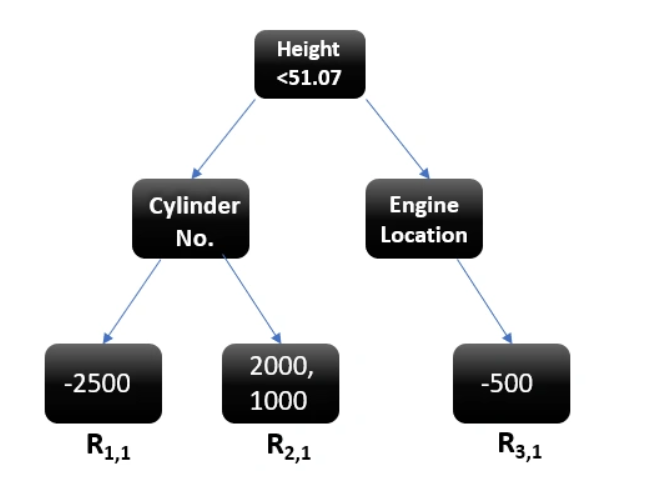
The following decision tree was created:
As you can see, there are some cases where we get more than 1 output per leaf (R2,1). We will replace these two values with a singular average for this leaf (1500)
Tree 1:
3. Update Predictions from Initial
This is the step where we go an update our prediction based off this new model we have created.
The updated prediction will look as following
The learning rate is a multiple chosen between 0 and 1 at the start of the project. This is chosen to ensure that no single decision tree has too much bearing on the final project, reducing theOverfitting problem. We will use 0.1 for this example
For example, the new predicted value for Item 1 will be:
Now we perform this prediction for all items in the table, calculate a list of all the new residual and again start from Step 2.
4. Conclusion
A fixed number of decision trees is decided upon at the beginning of the project and once that is reached, the full model will be ready to predict the data.
The hope is that as we continue along the decision trees, the residual amounts will decrease as we should be getting better at predicting the value